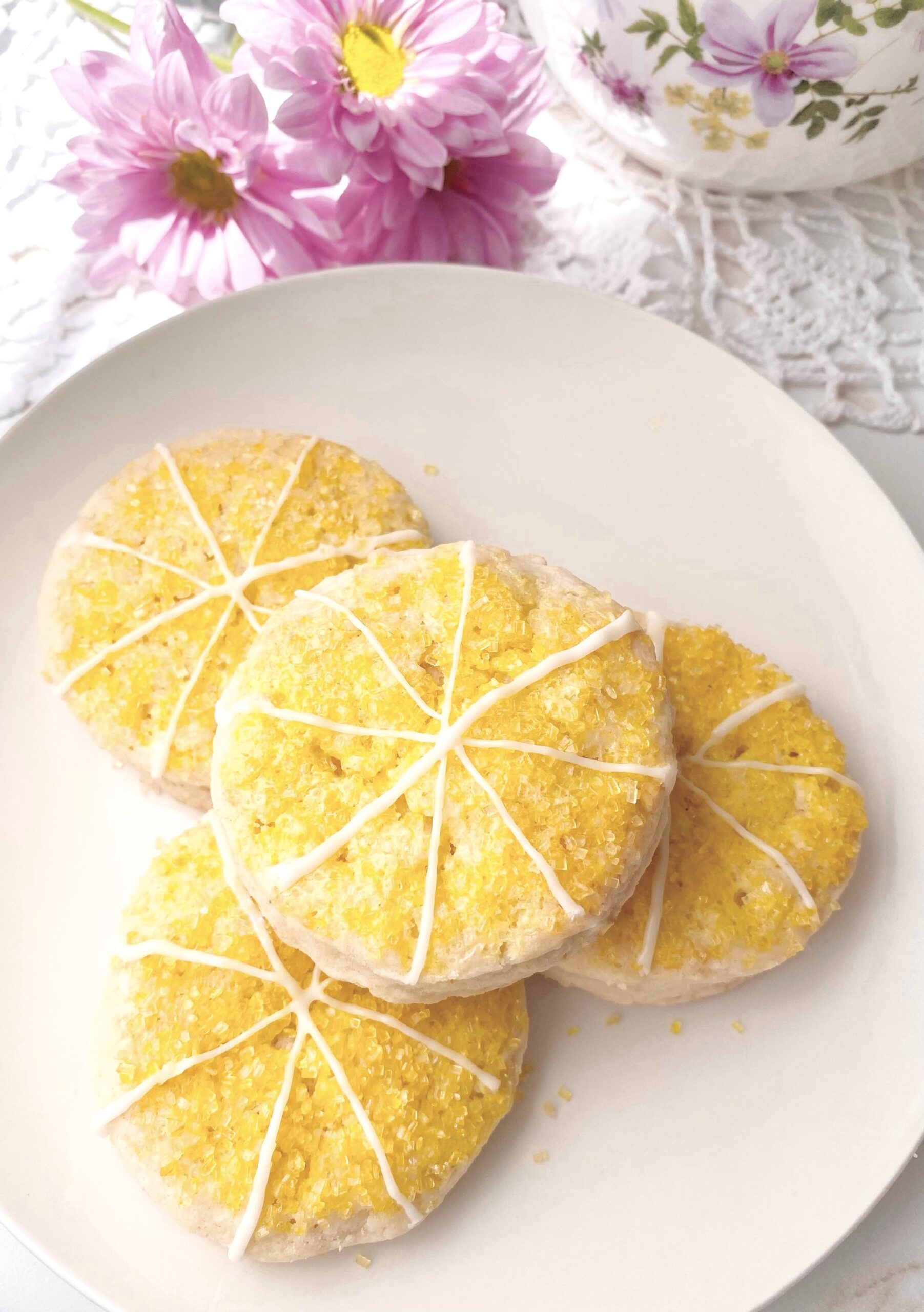
Yellow is the color of happiness and sunshine. These adorable Lemon Scones will bring you a burst of lemony brightness even on the grayest day. The pretty, vibrant yellow sparkling sugar adds a pleasant crunch to the tops. It’s a nice contrast to the soft, tender interior of the scones. These little gems would shine on any breakfast or brunch table. I served them with blueberry jam and green tea, which was so delightful, I’m still smiling.
Lavender and honey go so well together. Bees know it, fairies know it, princesses know it. The flavor combination is so delightful in these cookies, that I decided to share them with you. In addition to delicious, compatible flavors, these cookies have a divine texture combination. The shortbread cookies have a tender, melt-in-your-mouth texture. Together with the silky, smooth honey buttercream, they’ll make you feel fancy and regal. You’ll hold your head up higher, ring for your tea and declare that you do indeed deserve fine things!
Some people are nervous about baking with lavender because they don’t want their baked goods to taste like soap or perfume. That can be a concern if the lavender flavor is too pronounced. However, if you don’t use enough you won’t be able to taste it at all. There’s a fine balance. If you use the right amount, it will taste pleasant and have sweet undertones. I used two teaspoons of culinary lavender in these cookies, but you can adjust the amount to your tastes. You can start out with one teaspoon, bake a small sample of dough and taste it, to customize the flavor.
Speaking of tasting, my grandmother always said, “taste as you go.” This is also helpful when making the honey buttercream. Typically, when making other flavors of buttercream, you add more powdered sugar if your buttercream is too thin. In this case, adding more powdered sugar can make the buttercream too sweet. Once you have added the amount of honey that tastes good to you, you can add a little cornstarch if you need to stiffen it up a bit.
Lavender Shortbread Sandwich Cookies with Honey Buttercream
Tender lavender scented cookies with silky honey buttercream filling
In a large bowl, sift together the flour, sugar and salt.
In a separate large bowl, beat the butter with an electric mixer until smooth. Mix in the lavender. Beat in the flour mixture on low speed, just until combined.
Divide the dough into two discs. Wrap in plastic wrap and refrigerate for at least 1 hour, but not more than 8 hours.
Line 2 large baking sheets with parchment paper. On a lightly floured surface, roll the dough to 1/4-inch thickness. Cut into 2-inch circles. Place two inches apart on prepared cookie sheets. Refrigerate cut cookies for 30 minutes to 1 hour.
Preheat oven to 325ºF (165ºC). Bake cookies until the bottom edges are light golden brown, about 12-14 minutes.
Transfer cookies to a cooking rack to cool completely.
Pipe or spread about 1/2 tablespoon of buttercream on the bottom of half of the cookies. Top with remaining cookies.
Honey Buttercream
In a medium bowl, beat butter and sugar together until smooth. Add honey, one tablespoon at a time until desired sweetness and consistency is reached.
Mix in a pinch of salt to taste.
Mix in cornstarch, if necessary, to firm up buttercream. *See notes below.
Notes
*The addition of cornstarch helps to firm up buttercream without adding additional sweetness.To find culinary lavender, click here.
Once, some time ago, I made some soft, melt-in-your mouth cookies and posted them on the internet. A viewer got triggered and insisted that cookies must be crunchy. I have to disagree! Cookies can be crunchy, crisp, soft, chewy, sandy or anything your heart desires. These soft, pillowy cookies are light and airy like little clouds. They could almost be called little cakes. The texture is similar to whoopee pies, but not as sticky. They’re delightfully delicious and have been well-loved by my family for two generations. They’re perfect for a spring teatime treat or alongside a glass of lemonade at a picnic.
Lemon Blueberry Cloud Cookies
Soft, pillowy cookies made with ricotta cheese and fresh blueberries, topped with a tangy lemon icing
Preheat the oven to 350ºF (180ºC). Line two cookie sheets with parchment paper.
In a medium-size bowl, whisk together the flour, baking powder and salt until well combined.
In a large bowl, beat the butter, with an electric mixer on medium speed, until smooth Add the ricotta cheese, sugar and lemon zest. Beat until well combined. Beat in the egg and vanilla until incorporated. On low speed, gradually mix in the flour mixture, just until combined. Fold in the blueberries.
Place rounded tablespoon-size portions of dough about 2 inches apart onto the cookie sheets. Top the cookies with additional blueberries. (If your cookie dough is sticky and hard to work with, refrigerate it just until it's easier to work with, about 30 minutes to 1 hour.)
Bake until the bottom edges of the cookies are lightly browned, about 11-13 minutes. Transfer the cookies to a cooling rack. Top the cooled cookies with icing. Best eaten the day they're made.
Icing
In a medium-size bowl, whisk together the powdered sugar, melted butter, salt and 1 tablespoon (15ml) of lemon juice until well combined. Add additional lemon juice as needed to achieve the desired consistency. Whisk until smooth.
Purée the strawberries in a blender or small food processor. Pass the purée through a mesh sieve into a small saucepan. Stir in the sugar and 1/2 cup (118ml) of water. Bring the mixture to a boil over medium heat. Turn the heat down to low and simmer until the sugar has dissolved and the syrup thickens, about 10 minutes. Set aside to cool. Serve warm or at room temperature.
Pink Whipped Cream
In a large bowl, beat the whipped cream to soft peaks with an electric mixer at high speed. Add the powdered sugar, strawberry extract and food coloring in 3 separate additions. Continue beating just until stiff peaks are formed. Set aside in the refrigerator until ready to use.
Strawberry Rose Pancakes
In a large bowl, whisk the flour, sugar, baking powder and salt together until well combined. Set aside.
Purée the strawberries in a blender or small food processor. Pass the purée through a mesh sieve into a medium bowl. Add the egg, milk, melted butter, vanilla extract and food coloring (if using) and whisk until well combined. Stir this mixture into the flour mixture just until combined. A few lumps are okay. Stir in the rose petals.
For each pancake, scoop 3-4 tablespoons of batter onto a hot oiled griddle. Flip the pancakes when bubbles form on the surface. Continue cooking until the pancakes puff and are lightly browned.
Notes
*To find the gel food coloring I used, click here.**To find culinary dried rose petals, click here.
We’ve all heard our parents telling their childhood stories of walking miles to school and suffering worse hardships than we ever had to. My mom used to tell me stories like that, but she had a sense of humor, so her stories were always fun to listen to. She used to tell me about her friend’s mother, who would make big, delicious oatmeal cookies. My mom would trade her baloney sandwich nearly every day to get one of those cookies from her friend. She reminisced about those cookies so much, that I set out to make her some when I learned to bake. She and my grandmother would taste test batch after batch of my cookies over the years. I have probably baked enough oatmeal cookies to circle the earth. Okay that’s an exaggeration, but seriously I have baked quite a few. Of all the oatmeal cookies I’ve baked, these are one of my favorites!
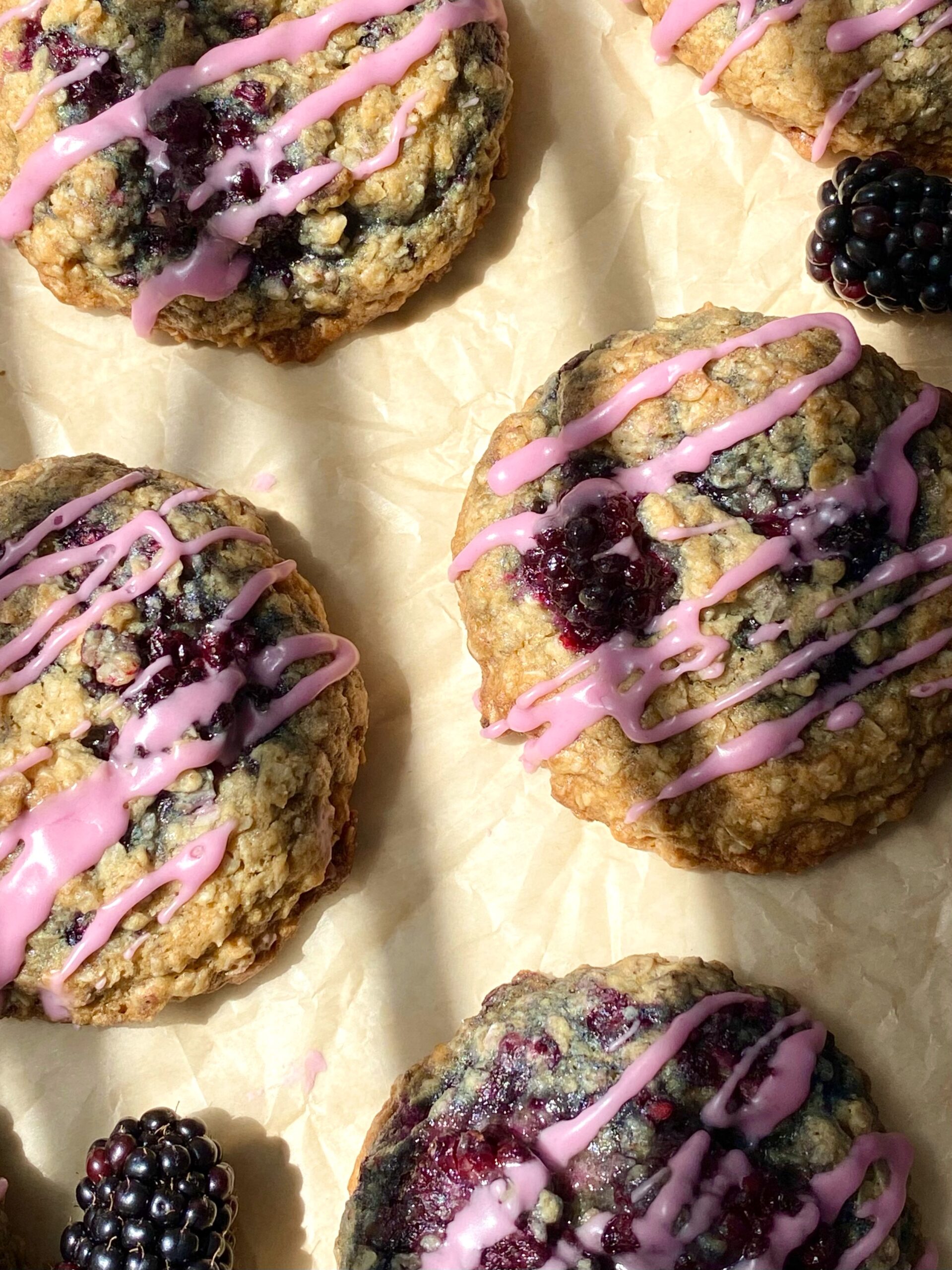
Most of the time when you see fruit added to an oatmeal cookie, it’s dried fruit, like raisins or cranberries. That’s mostly because if you just dump fruit into your cookie dough, the fruit releases water, leaving soggy spots in your cookies. To solve that issue, for this recipe, I macerate the blackberries before baking. The purple blackberry juice that’s released from the berries is used to make a beautiful lilac icing to drizzle over the cookies.
2cups (about 8-10 oz or 227-283g)fresh blackberriesCut large berries in half
2tablespoons (25g)granulated sugar
Oatmeal Cookies
1 ¾cups (7 7/8 oz or 223g)all purpose flour, sifted
1 teaspoonbaking soda
1teaspoonfine sea salt
½teaspoonground cinnamon
½cup (4 or 113g)unsalted butter, softened
1 ¼cups (8 3/4 oz or 250g)packed brown sugar
2 largeeggs
1 ½teaspoonspure vanilla extract
3cups (10 oz or 283g)quick oatsNot instant oats
Icing
¾cup (3 oz or 85g)powdered sugar, sifted
1tablespoon heavy cream
2-3tablespoonsreserved juice from blackberries
Instructions
In a small, light colored saucepan, melt 1/2 cup (4 oz or 113g) of butter over medium heat, stirring occasionally, until deep golden and fragrant. Keep a close eye on it. It can go from toasted to burned very quickly. When you see brown particles form, remove from heat and immediately transfer the butter, including the particles, to a small bowl. Refrigerate until solid, about one hour.
Place the blackberries in a medium-size bowl. Sprinkle with granulated sugar and toss to coat. Let sit for 30 minutes until the berries release their juices.
Drain the blackberries and reserve the juices.
Preheat oven to 350ºF (180ºC). Line two large cookie sheets with parchment paper.
In a separate medium-size bowl, whisk together the flour, baking soda, salt and cinnamon. Set aside.
In a large bowl, beat the brown butter, softened butter and brown sugar until light and fluffy.
Add the eggs and vanilla extract in three separate additions and beat until well combined.
Stir in the flour mixture just until combined. Stir in the oats just until combined. Gently fold in the blackberries.
Scoop 1/4 cup sized portions of dough, about 2 inches apart, onto the prepared cookie sheets. *I used a #16 2-ounce scoop.
Bake until the cookie tops are set and the edges are golden brown, about 13-15 minutes. Transfer the cookies to a cooling rack to cool completely.
Pass reserved blackberry juice through a sieve to remove the seeds.
In a small bowl, whisk together the powdered sugar, heavy cream and one tablespoon of the reserved blackberry juice until smooth. Add more blackberry juice, a little at a time, until the desired consistency is reached. Drizzle the icing over the cooled cookies.
This cheerful little loaf cake feels like a spring or summer picnic with lemonade and sunshine. It’s similar to a pink lemonade cake that my elderly neighbor used to make when I was growing up. She made it for all the neighborhood kids and we always gobbled it up. When I was about ten years old she taught my friend and me how to make it. She used a yellow cake mix in a large baking pan and poked holes all over the cake, then drenched it in a pink, sugary lemon icing. I transformed that happy pink lemonade memory into a delightful loaf cake made from scratch.
1-2dropspink gel food colorI used Americolor deep pink*
Lemon Syrup
Juice of one lemon
¼cup (50g)sugar
Icing
2tablespoons (28g)unsalted butter, softened
1cup (120g)powdered sugar, sifted
2-2 ½tablespoons (30-37ml)lemon juice
½teaspoonstrawberry extract
1pinchfine sea salt
1tiny droppink gel food coloringI used Americolor deep pink*
Instructions
Pink Lemonade Cake
Preheat the oven to 325ºF (163ºC). Line the bottom of an 8 X 4-inch loaf pan with parchment paper. Grease and flour the insides.
In a medium-sized bowl, whisk together the flour, baking powder, salt and baking soda until well combined.
In a small bowl, whisk together the milk and sour cream until well blended.
In a large bowl, beat the sugar, oil, eggs, lemon zest, and strawberry extract, with an electric mixer on medium speed, until smooth, creamy and well blended. Mix in the food coloring, a little at a time, until your desired shade of pink is achieved.
Stir in the flour mixture in two additions, alternating with the milk mixture. Stir just until combined.
Transfer the batter to the prepared baking pan. Bake until a toothpick inserted into center of the loaf comes out clean, about 45-50 minutes. Meanwhile, prepare the lemon syrup.
Let the cake cool in the pan for 10 minutes, then remove from it from the pan and transfer it to a cooling rack. Poke holes all over the top of cake with a skewer. Brush the warm cake generously with the lemon syrup. Let the cake cool completely, then top with icing.
Lemon Syrup
In a small saucepan, combine the juice of one lemon with enough water to equal 1/4 cup (59ml). Add the sugar and stir over medium-low heat until sugar is dissolved. Remove from heat.
Icing
In a medium-sized bowl, beat the butter, powdered sugar, 1 tablespoon (15ml) lemon juice, the strawberry extract and a pinch of salt, until smooth. Add more lemon juice until your desired consistency is reached. Mix in the food color a little at a time and whisk until smooth.
I don’t think I’ve ever created a recipe that delighted all of my senses as much as these cookies. I used dried rosebuds in the cookie dough, but you can also use dried rose petals. Whether you purchase dried rose petals or make them yourself, they’re pleasantly fragrant with a subtle flavor. To find dried rose petals, click here. To find dried rosebuds, click here. I pinched the calyx and stem off of the rosebuds to avoid large crunchy bits in the cookies, then I crushed the roses with a mortar and pestle. You’ll hear the satisfying crunch of the delicate, dried rose petals. You can also place them in a plastic bag and roll over them gently with a rolling pin.
The finished cookies have a rustic, almost shabby chic look with their cracks, rose-speckled dough and beautifully imperfect dried roses. And of course, you’ll want to sample a warm cookie. The cookies will taste tender and slightly sweet with a hint of rose. I like a more subtle rose flavor in my baked goods. But if you prefer a stronger rose flavor, feel free to add a small amount of rose water to your dough. Start with 1/4 teaspoon, because a little goes a long way.
If you’re like me, you’ll taste a spoonful of the raspberry ganache because you can and should. For the raspberry ganache, please use a good quality white chocolate! In some recipes, it’s fine to use white chocolate chips or candy melts if you prefer, but NOT this one. In my humble, yet educated opinion, you should never use chocolate chips to make ganache. I studied chocolate in culinary school with a master chocolatier. I never use chocolate chips for ganache because they contain stabilizers that keep them from melting completely, which prevents you from having the smoothest ganache possible. They also contain less cocoa butter and tend to have a waxy mouth feel.
For this recipe, when it comes to butter, you should also be a little bit picky for successful baking. Low quality butter tends to contain more water and your cookies may spread too much. So make sure to use good butter. Your butter should be room temperature, but not warm. If the butter is shiny, it’s too warm. Don’t try to speed up the softening of butter with your microwave. That’s not a hack, in spite of what you may hear on the internet. Microwaves heat unevenly and will potentially melt your butter. The best way to speed up the softening of your butter is to simply cut it into cubes. By the time you get the rest of your ingredients ready, the butter should be soft enough to use. My last, but most important success tip, is to weigh your ingredients.
You’ll find this recipe and more delightful bakes, in my cookbook “Enchanted Baking.” Click here for more info.
Raspberry Rose Shortbread Cookies
Mari Vasseur
Rose petal shortbread cookies filled with white chocolate raspberry ganache
3ounces (or 85g)white chocolate, finely choppedDo not use white chocolate chips
30dried rosebuds for decorationoptional
Instructions
Cookies
Preheat the oven to 350ºF (180ºC). Line two large baking sheets with parchment paper
In a large bowl, beat the butter, with an electric mixer on medium speed, until smooth. Add the rose petals and beat on low speed until combined.
Add the powdered sugar, vanilla extract and salt. Beat until well combined.
On low speed, mix in the flour in two additions. Beat just until combined.
Roll the dough into 1 1/4-inch balls, about 1/2 ounce (14g) each. Place the dough balls about 2 inches apart onto the prepared baking sheets.
Bake for 7 minutes, then remove from the oven. Press indentations into each cookie with a 1-inch diameter pastry tamper or with the flat top of a 1-inch diameter bottle cap.
Return the cookies to the oven and continue baking until the edges are light golden brown, about 5-6 more minutes.
If the indentations in your cookies lose definition, press again with the tamper or bottle cap while the cookies are still hot on the baking sheet.
Transfer the cookies to a cooling rack to cool completely.
Filling
In a small saucepan, bring the pureéd raspberries to a simmer over medium heat. Simmer until the purée is reduced by half, about 5 minutes. Transfer the raspberry reduction to a small bowl and set aside.
Place the white chocolate in a medium heat safe bowl and set aside.
In a small saucepan over medium heat, bring the heavy cream to a simmer, just until bubbles form around the edges. Do not boil. Stir in the raspberry reduction and heat just to a simmer again. Do not boil.
Pour the hot cream mixture over the white chocolate, making sure all of the white chocolate is submerged. Let it sit for 3 minutes, then stir with a spatula until smooth. Let the ganache cool until slightly thickened. Spoon about 1/2 teaspoon into the indentation of each cookie. The ganache will continue to firm up as it sits.
When the ganache in the cookies has firmed up, decorate with dried rosebud or rose petals, if desired.
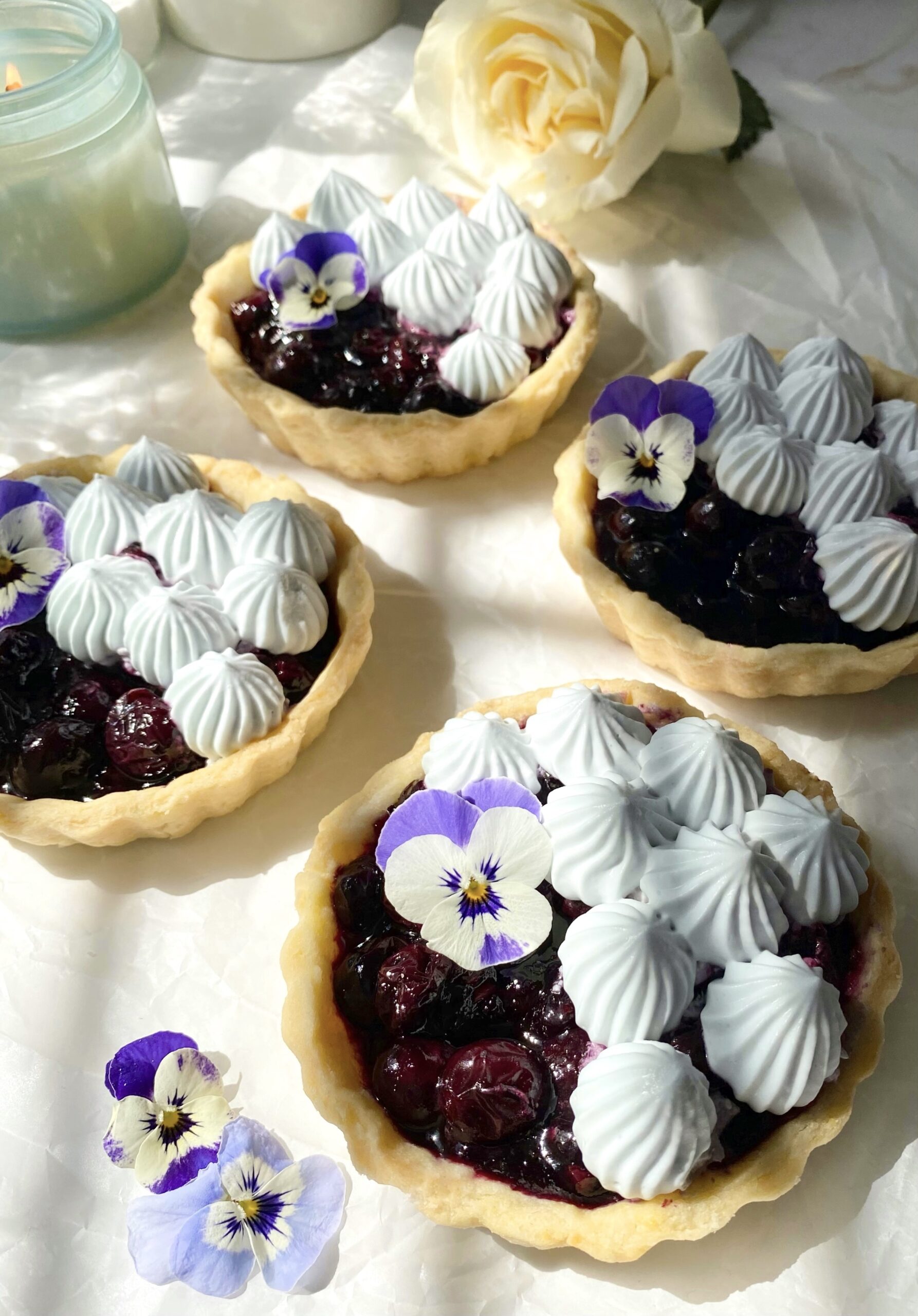
These Blueberry Earl Grey Tarts have three individual components, which, when combined together, are absolutely delicious. I experimented with each separate component of this recipe until I perfected them individually. The tart crust is flaky and tender, yet sturdy enough to hold the filling. The filling is just sweet enough for my sweet tooth and the whipped cream has just enough Earl Grey flavor.
This recipe makes enough whipped cream to cover the entire tops of the tarts or you can be like me and try to be artistic and avant-garde with your whipped cream. To make the Earl Grey infused whipped cream, use your favorite Earl Grey tea, whether it’s loose leaf tea or a teabag. We don’t discriminate here. All forms of tea are welcome! I do have a favorite Earl Grey tea. If you want to check it out, click here. The tea will make your whipped cream a dull pale yellow. This issue is purely aesthetic. I added a tiny bit of violet gel food color which brightens the whipped cream. You can add more if you want a lavender shade.
Blueberry Earl Grey Tarts
Mari Vasseur
Personal-sized tarts with sweet blueberry filling, topped with Earl Grey whipped cream
In a large bowl, whisk together the flour, powdered sugar and salt until well blended. Work in the butter and egg yolk, with a pastry blender or with your fingertips, until pea sized pieces are formed. Add ice water one tablespoon (15ml) at a time until the dough comes together.
Form the dough into a disk. Wrap in plastic wrap and chill in the refrigerator for at least one hour or up to overnight.
On a lightly floured surface, roll the dough to a scant 1/4-inch thickness. Cut the dough into six 5-inch rounds.
Press the rounds into six 4-inch or 4 1/4-inch tart pans. Dock the bottoms of the tart crusts with a fork. Freeze for 30 minutes.
Meanwhile, preheat oven to 375ºF (190ºC). Place the tart pans on a large baking sheet. Line the tart shells with 6-inch parchment rounds. Fill with pie weights. (You can use dried beans or rice if you don't have pie weights.)
Bake the tart shells for 12 minutes. Remove the parchment paper and pie weights. Continue baking until the tart shells are light golden brown, about 4-6 more minutes.
Blueberry Filling
Set aside 1 cup (155g) blueberries. Combine the remaining 3 cups blueberries, sugar, corn starch and lemon juice in a medium-sized saucepan.
Simmer over low heat, stirring occasionally, until blueberries are softened and sauce is thickened, about 5 minutes. Stir in the reserved 1 cup of blueberries during the last minute of cooking. Remove from heat and let cool completely.
Earl Grey Whipped Cream
Combine the heavy cream and tea leaves or tea bag in a small saucepan. Heat just until bubbles form around the edges.
Transfer the mixture to a small bowl, cover with plastic wrap and let cool. Pass the cream through a sieve to strain the out tea leaves or remove the tea bag. Cover the surface with plastic wrap and place in refrigerator to chill.
Transfer the chilled cream to a large bowl. Whip with an electric mixer until thickened. Add the powdered sugar and food color in separate additions and continue whipping at high speed just until stiff peaks begin to form.
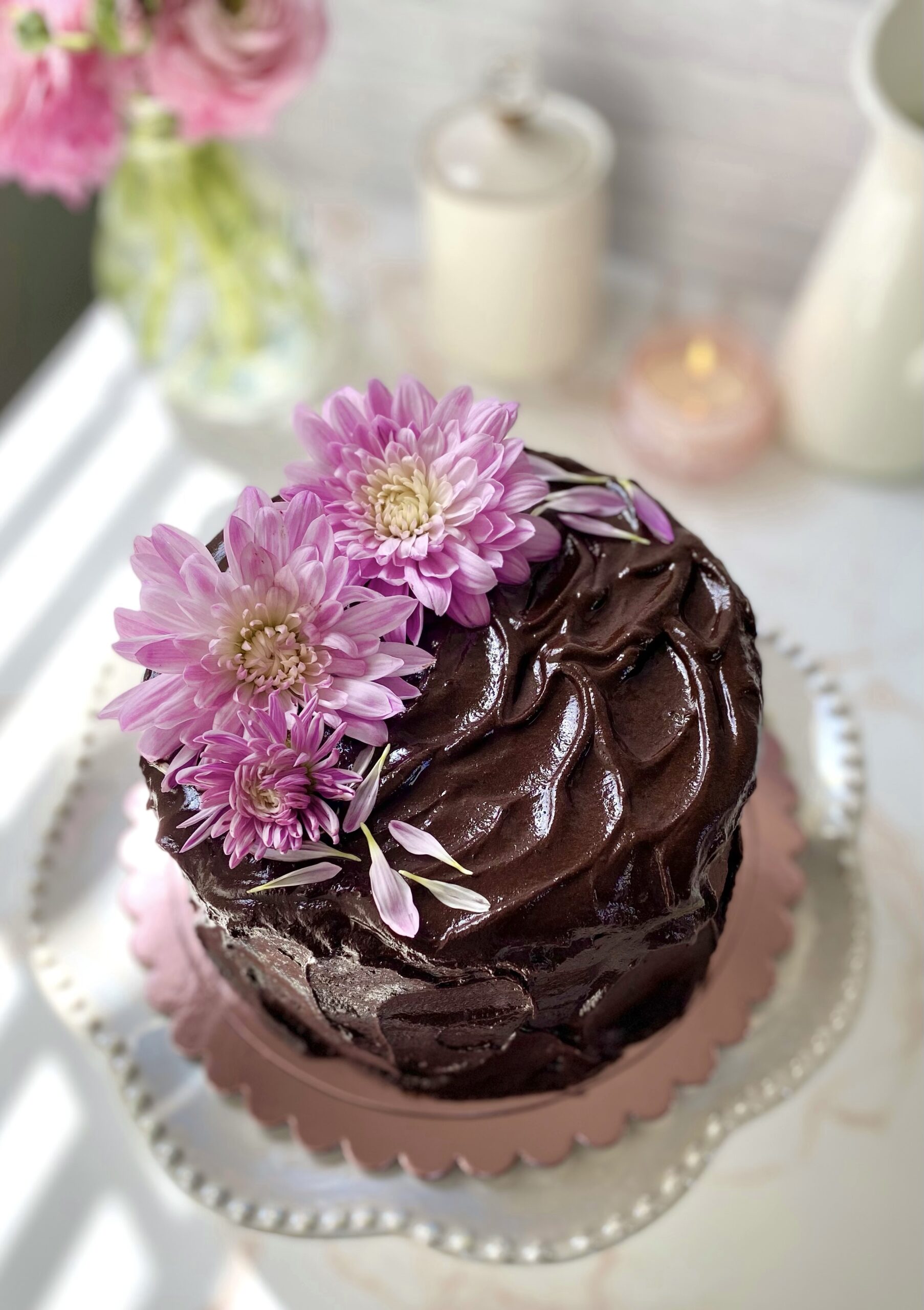
If you love chocolate cake, this is the post for you! Chocolate cake is one of the best comfort foods there is. I’ve tasted many over the years, but my all time favorite was one I had growing up. I’ve spent years trying to duplicate the moist, nostalgic cake from my childhood. I noticed that nearly every chocolate cake recipe on the internet is a variation of the century-old recipe from the Hershey’s Cocoa tin. I think many people have passed it down as a family recipe, each grandmother adding her own personal touch. Even some celebrity chefs have claimed it as their own. It’s an easy, delicious, moist recipe and its popularity is well deserved. You can tweak the flavor additions a bit to make it your own too. It’s a recipe that’s hard to mess up.
This cake is topped with the ultimate silky, smooth, deeply chocolate frosting. I developed this recipe mostly because I couldn’t find a chocolate frosting recipe that didn’t taste gritty and/or look speckled from the cocoa powder. Swiss meringue buttercream with melted chocolate added is one alternative. But, while it is smooth, silky and perfect for piping, it’s missing that deep chocolate richness. Another option is chocolate ganache. It looks rich and creamy in those viral videos, but it’s a little too rich and overpowering to use as frosting in my opinion.
I think this frosting is the one! It has the best of both worlds, velvety but not too rich. You’ll notice that this frosting contains maple syrup. The syrup gives it a very subtle maple flavor in the background, but mostly, it helps to make the frosting silky and gives it shine. You can adjust the sweetness level of the frosting by choosing the chocolate you prefer. I used bittersweet chocolate, which I think is just right. This recipe makes enough frosting to frost a 2-layer 6-inch cake. You can easily double the recipe for larger cakes.
Vintage Chocolate Cake
by Mari Vasseur
Rich moist classic chocolate cake with silky chocolate buttercream frosting
1 ⅛cup (145g)all purpose flour, siftedPlus more for dusting the pans
½cup (45g)unsweetened cocoa powder, siftedPlus more for dusting the pans
1teaspoonbaking powder
½teaspoonbaking soda
¾teaspoonfine sea salt
1 ⅓cups (265g)sugar
1largeegg
1largeegg yolk
⅔cup (155ml)buttermilk
⅓cup (70ml)vegetable oil
1 ½teaspoonspure vanilla extract
⅔cup (155ml)hot coffee or espresso
Chocolate Buttercream Frosting
½cup (148ml)pure maple syrup
3tablespoons (45ml)water
¾cup (67g)unsweetened Dutch process or dark cocoa powder, sifted
½teaspoonespresso powderoptional
1 ¼cups (283g)unsalted butter, softened
1cup (113g)powdered sugar, sifted
⅛teaspoonfine sea salt
8oz (227g)dark, bittersweet or semi-sweet chocolate, chopped*not chocolate chips
Instructions
Chocolate Cake
Preheat the oven to 350ºF (180ºC). Line the bottoms of two 6-inch cake pans with parchment paper. Grease the insides and dust with a mixture of equal parts flour and cocoa powder. Wrap the cake pans with damp cake strips if you have them.
Sift the flour, cocoa powder, baking powder, baking soda and salt together in a medium-sized bowl. Add the sugar and stir until well blended.
Combine the the egg, egg yolk, buttermilk, vegetable oil and vanilla extract in a small bowl. Whisk lightly to combine.
Add the egg mixture to the dry ingredients and beat, on low speed with an electric mixer, until combined. Stop the mixer. Scrape the sides and the bottom of the bowl with a spatula. Turn the mixer up to medium speed and beat for 30 seconds. Add the hot coffee and stir until well combined.
Pour the batter into the prepared cake pans, dividing batter evenly between the pans. Bake until a toothpick inserted into the center of the cakes comes out clean, about 25-28 minutes without cake strips or about 28-32 minutes with cake strips.
Let the cakes cool in the pans for 10 minutes then remove the cakes from the pans and transfer to a cooling rack.
Trim the cake layers to your desired thickness, from 1-inch to 1 1/2-inches thick. Fill and frost with chocolate buttercream frosting.
Chocolate Buttercream Frosting
In a small saucepan over low heat, whisk together the maple syrup, water, cocoa powder and espresso powder until smooth. Set aside to cool to room temperature.
Melt the chocolate in a medium-sized heat safe bowl set over a pan of gently simmering water, making sure the water doesn't touch the bottom of the bowl. Remove from heat and set aside to cool to lukewarm.
In a large bowl, beat the butter with an electric mixer at medium speed, until smooth and pale. Add the powdered sugar and salt and continue beating until smooth and well combined. Gradually add the the cooled maple syrup mixture and beat on low speed until combined. Stir in the melted chocolate until well blended. Smooth out any air bubbles by stirring gently with a rubber spatula.
Notes
*For smoothest results, use chopped bar chocolate and make sure chocolate is completely melted. Do not use chocolate chips. Chocolate chips do not melt completely and can make your frosting lumpy.
If you’ve landed here from Instagram, welcome! You’ll notice that this is an ad-free website with no annoying pop-ups. I work very hard creating and testing delicious recipes to share with you. So if you like this recipe or any of my other popular recipes, make sure to follow me on Instagram and/or TikTok.
This is the ultimate silky, smooth, deeply chocolate frosting. I developed this recipe mostly because I couldn’t find a chocolate frosting recipe that didn’t taste gritty and/or look speckled from the cocoa powder. Swiss meringue buttercream with melted chocolate added is one alternative. But, while it is smooth, silky and perfect for piping, it’s missing that deep chocolate richness. Another option is chocolate ganache. It looks rich and creamy in those viral videos, but it’s a little too rich and overpowering to use as frosting in my opinion.
I think this frosting is the one! It has the best of both worlds, velvety but not too rich. You’ll notice that this frosting contains maple syrup. The syrup gives it a very subtle maple flavor in the background, but mostly, it helps to make the frosting silky and gives it shine. You can adjust the sweetness level of the frosting by choosing the chocolate you prefer. I used bittersweet chocolate, which I think is just right. This recipe makes enough frosting to frost a 2-layer 6-inch cake. You can easily double the recipe for larger cakes.
The Best Chocolate Buttercream Frosting
by Mari Vasseur
Silky smooth chocolate frosting with an intense chocolate flavor
¾cup (67g)unsweetened Dutch process or dark cocoa powder, sifted
½teaspoonespresso powderoptional
8ounces (113g)bittersweet 70-72%) or semisweet chocolate, choppedNot chocolate chips**
1 ¼cups (283g)unsalted butter, softened
1cup (113g)powdered sugar, sifted
⅛teaspoon fine sea salt
Instructions
In a small saucepan over low heat, whisk together the maple syrup, water, cocoa powder, and espresso powder until smooth. Remove from heat and set aside to cool to room temperature.
Melt the chocolate in a medium-sized bowl set over a pan of barely simmering water, making sure the water doesn't touch the bottom of the bowl. Stir gently until smooth. Remove from heat and set aside to cool to lukewarm.
In a large bowl, beat the butter with an electric mixer at medium speed, until smooth and light in color. Add the powdered sugar and salt and continue beating until smooth and well blended.
Gradually add the cooled maple syrup mixture and beat on low speed until combined. Stir in the melted chocolate until well blended. Smooth out any air bubbles by stirring gently with a rubber spatula.
Notes
*To find my favorite Dutch process cocoa powder, click here.**For the smoothest results, use chopped bar chocolate and make sure chocolate is completely melted. Do not use chocolate chips. They contain an ingredient which prevents them from melting completely and may make your frosting lumpy.
Sending sunshine your way with these cute, delicious bite-size mini cakes. Lemon Buttermilk Cakelets are tender and moist with a burst of fresh lemon flavor. They’re easy to make and they bake up quickly. They make an adorable addition to a spring teatime, baby shower or summer picnic.
½cup (115ml)vegetable oil or neutral oil of your choice
2largeeggs
2teaspoons lemon zest
½teaspoonpure vanilla extract
½teaspoon pure lemon extract
½cup (118ml)buttermilk
Icing
1 ½cups (180g)powdered sugar, sifted
1tablespoon (14g)unsalted butter, melted
3-4tablespoons (45-60ml)fresh lemon juice
Instructions
Lemon Simple Syrup
Measure the juice of 1 lemon. Add enough water to equal 1/4 cup (89ml). In a small saucepan, simmer the lemon juice and water mixture with the sugar and lemon zest, stirring occasionally, until the sugar is dissolved. Set aside to cool, then strain out the lemon zest.
Cakelets
Preheat the oven to 350ºF (180ºC). Grease and flour a 24-serving mini muffin pan* or use liners.
In a medium-sized bowl, whisk the flour, baking powder, baking soda and salt together until well blended.
In a large bowl, whisk the sugar, oil, eggs, lemon zest and extracts together until smooth and well blended. Mix in the flour mixture in 2 additions alternating with half of the buttermilk after each addition. Stir just until combined. Do not over mix.
Fill the muffin cups 2/3 full. (I used a portion scoop). Bake until a toothpick inserted into the center of the cakes comes out clean, about 8-10 minutes. Be careful not to over bake to avoid drying out the cakes. Let the cakes cool in the pan for 5 minutes, then remove them from the pan and transfer them to a cooling rack. (Repeat with any remaining batter.)
Icing
In a medium-sized bowl, whisk together the powdered sugar, melted butter and 3 tablespoons of lemon juice. Add additional lemon juice as needed to achieve the desired consistency. Whisk until smooth. Spoon the icing over the cooled cakes.
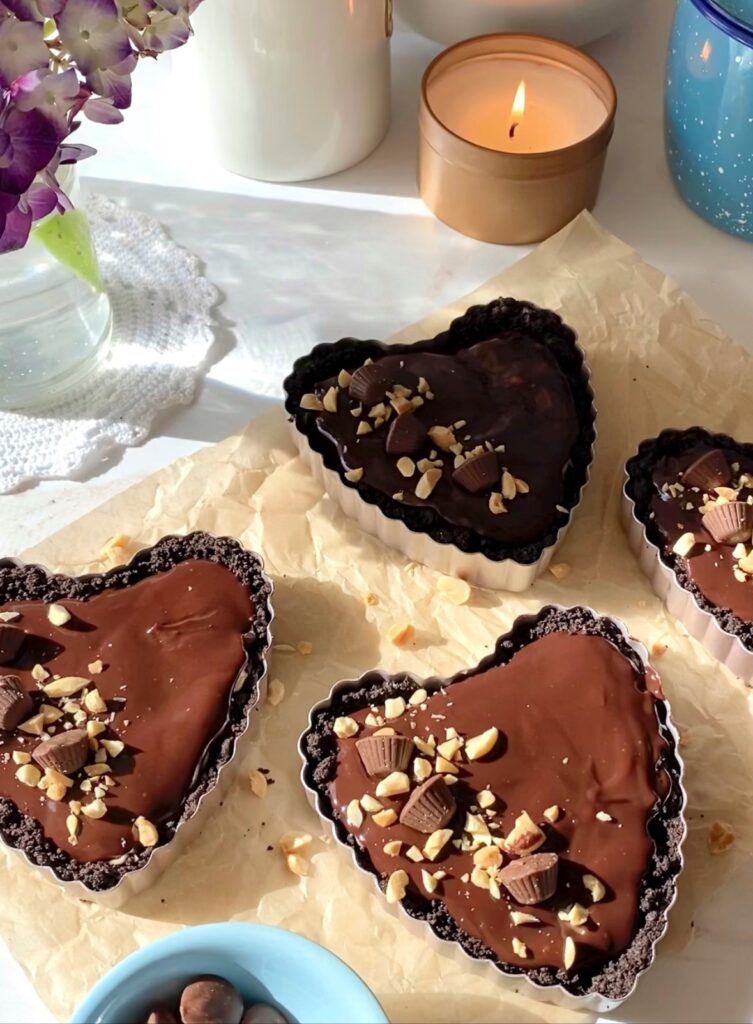
Chocolate and peanut butter is a rich, delicious and nostalgic combination. If you love chocolate and peanut butter together, you’ll absolutely love these tarts. The creamy peanut butter filling and the silky chocolate ganache topping are perfect together. The chocolate cookie crust adds a nice crunch. I used heart shaped tart pans to make the tarts a little more special for Valentine’s Day. To find the tart pans I used, click here. You can also use round tart pans if you prefer.
Chocolate Peanut Butter Tarts
Mari Vasseur
Personal peanut butter tarts with chocolate cookie crusts and chocolate ganache topping
3ounces (85g)bittersweet or semi-sweet chocolate, finely chopped
¼ cupplus 2 tablespoons (88ml)heavy cream
Chopped peanutsoptional
Mini peanut butter cupsoptional
Instructions
Crust
Preheat the oven to 350ºF. (180ºC). Place four 4-inch tart pans with removable bottoms* on a baking sheet.
In a medium-sized bowl, mix the crushed sandwich cookies with the melted butter until well combined. Press the crumb mixture into the tart pans.
Bake for 8 minutes. Let cool completely.
Filling
In a medium-sized bowl, beat the peanut butter and softened butter until smooth. Add the remaining filling ingredients and beat until smooth and well blended.
Fill the cooled tart shells with the filling. Refrigerate the tarts until set, at least 2 hours.
Topping
Place the chopped chocolate in a small bowl.
In a small saucepan, heat the heavy cream over medium-low heat just until bubbles form around the edges. Do not boil. Pour the hot cream over the chocolate. Let sit two minutes then stir until smooth.
Spoon over the peanut butter filling. Add toppings if desired. Refrigerate until chocolate is set. Carefully remove tarts from pans.