Lilac Vanilla Mini Cakes

Lilac Vanilla Mini Cakes

Once upon a time, there was a little black bear who woke up from a long nap. As she stretched, she felt her tummy growl. She ventured into the morning sunshine and smelled something sweet. She sniffed the air, following the sweet fragrance until she came upon a beautiful purple tree. She climbed up to a comfy branch and ate the tender, purple blossoms to her heart’s content.

Bears, butterflies and bees know something good when they see it. We humans can also enjoy lilacs. I knew lilacs were edible, but I hadn’t tasted them until recently. The flavor reminds me of beets, slightly sweet with a vegetable aftertaste. I really wanted to try lilac syrup after seeing so many photos of pretty purple syrup online. I discovered that lilac syrup is not purple. It’s more of a dull, brownish blue-green. Many people use food coloring or blueberries to color their syrup. I also discovered that lilac syrup will turn a pretty shade of mauve by adding a small amount of lemon juice to the finished syrup. Since I would be using my lilac syrup inside of cake layers, I let it remain its natural color. I made a simple syrup with lilac blossoms and let them steep for a couple of hours. It was just long enough to give a subtle lilac flavor without being too floral. If you want a stronger lilac flavor, I suggest using more lilac blossoms rather than steeping longer to avoid bitterness.

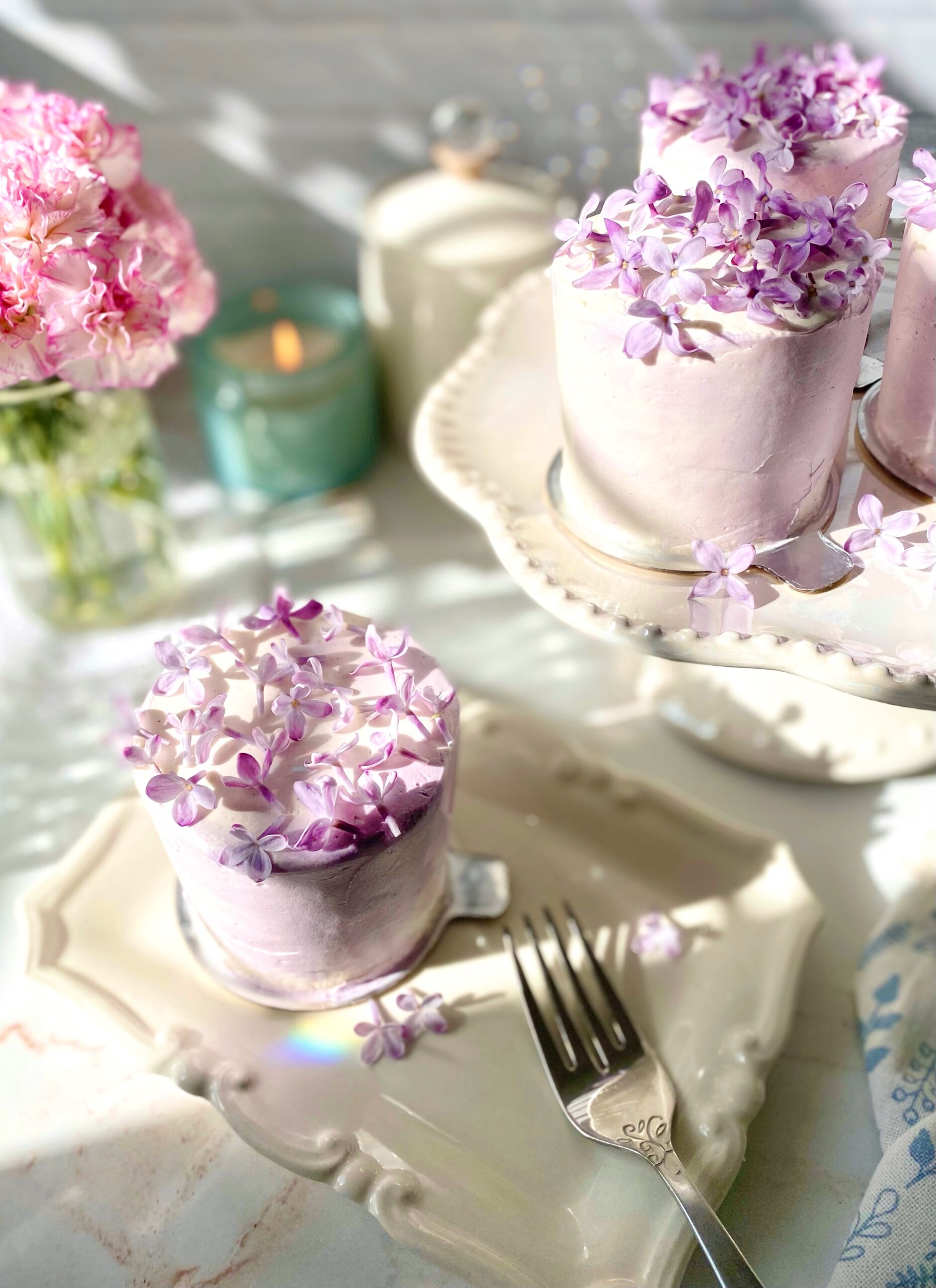
I paired the lilac syrup with this soft, fluffy vanilla cake and silky Swiss meringue buttercream. If you aren’t a fan of lilac syrup, feel free to use vanilla simple syrup instead and just use the lilac blossoms to decorate your cakes. They look stunning on any cake or cupcakes.


Lilac Vanilla Mini Cakes

by Mari Vasseur
Soft, fluffy mini white vanilla cakes with lilac syrup and vanilla Swiss meringue buttercream, topped with lilac blossoms
Course Dessert
Servings 6 mini cakes

Ingredients
  

Lilac Syrup

  • ½ cup (100g) sugar
  • ½ cup (118ml) water
  • ½ cup (7g) lilac blossoms, rinsed and all stems removed
  • 1 teaspoon fresh lemon juice optional

White Vanilla Cake

  • 2 ¾ cups (319g)) cake flour, sifted
  • 2 teaspoons baking powder
  • 1 teaspoon fine sea salt
  • ½ cup (113g) unsalted butter, softened
  • 1 ¾ cups (350g) ultra fine granulated sugar* Not powdered sugar
  • ¼ cup (2 oz or 57ml) vegetable oil or neutral oil of your choice
  • 2 teaspoons vanilla bean paste or pure vanilla extract
  • 4 large egg whites, room temperature
  • 1 large egg, room temperature
  • ½ cup (118ml) sour cream, room temperature
  • 1 cup (237ml) whole milk, room temperature

Swiss Meringue Buttercream

  • 4 large egg whites
  • 1 ⅓ cups (265g) ultra fine granulated sugar* Not powdered sugar
  • 1 ½ cups (340g) softened, unsalted butter, cubed
  • 1 teaspoon vanilla bean paste or pure vanilla extract
  • ¼ teaspoon fine sea salt
  • 1-2 drops lilac gel good color See notes below
  • 1 drop violet gel food color See notes below

Assembly

  • 6 3-inch mini cake boards**** See notes below
  • Lilac blossoms, rinsed and all stems removed

Instructions
 

Lilac Syrup

  • In a small saucepan combine the sugar and water. Bring to a boil over medium heat, stirring gently to dissolve the sugar. Add the the lilac blossoms and stir gently. Turn the heat down and simmer for 5 minutes.
  • Remove from heat and allow the lilac blossoms to steep for 2 hours. Pass the lilac syrup through a mesh sieve.

White Vanilla Cake

  • Preheat the oven to 350ºF (180ºC). Grease and flour two 9-inch round cake pans and line the bottoms with parchment paper.
  • In a medium-sized bowl, whisk together the cake flour, baking powder and salt until well blended.
  • In a large bowl, beat the butter, sugar, oil and vanilla bean paste with an electric mixer at medium speed, until pale and fluffy, about 3 minutes.
  • On medium speed, beat in the egg whites in two additions, then beat in the egg until incorporated. On low speed, beat in one third of the flour mixture, then beat in the sour cream just until combined. Beat in the remaining flour mixture in two additions, alternating with milk. Beat just until combined.
  • Transfer the batter to prepared cake pans. Bake until the tops of the cakes are light golden brown and a toothpick inserted in center comes out clean, about 28-33 minutes. Do not over bake.
  • Allow the cakes to cool in the pans for 10 minutes, then remove from the pans and transfer to a cooling rack.
  • Cut each cake into four 2 3/4-inch rounds using a cookie or biscuit cutter.
  • Using a pastry brush, brush the mini cakes generously with lilac syrup or vanilla simple syrup.

Swiss Meringue Buttercream

  • Combine the egg whites and sugar in a large heatproof bowl. Set over a pan of gently simmering water, making sure the water doesn't touch the bottom of the bowl.
  • Whisk constantly until the sugar is dissolved and a temperature of 160ºF (71ºC) is reached.
  • Transfer the mixture to the bowl of a stand mixer with a whisk attachment. Whisk on low speed, gradually increasing to medium-high speed. Whisk until glossy, stiff peaks form and the mixture reaches room temperature.
  • Turn the mixer to medium-low speed. Add the butter, a few pieces at a time, allowing it to fully incorporate before adding more. If the mixture looks curdled, keep mixing and it will correct itself.
  • Switch to a paddle attachment. On low speed, mix in the vanilla bean paste and salt. Continue mixing on low speed for a few minutes until smooth.
  • Remove about 3/4 cup of frosting and transfer it to a small bowl. Using a toothpick, place two tiny drops of lilac gel food color and one tiny drop of violet gel food color into the bowl. Mix with a spatula until well combined.

Assembly

  • Smear a bit of frosting on each mini cake board. Top each one with a cake round, a layer of frosting, then a second cake round. Frost with a crumb coat if desired. Refrigerate of 15 minutes. Frost the mini cakes with white Swiss meringue buttercream, then smear small amounts of lilac Swiss meringue buttercream around the sides and top. Smooth frosting with a bench scraper and smooth the tops with a small offset spatula. Decorate with lilac blossoms.

Vanilla Simple Syrup (optional)

  • Combine 1/2 cup sugar and 1/2 cup water in a small saucepan. Bring to a boil over medium heat, stirring gently to dissolve the sugar. When the sugar has dissolved, remove from heat and stir in 1 teaspoon vanilla bean paste or pure vanilla extract.

Notes

*If you can't find ultra fine granulated sugar, it's okay to substitute with regular granulated sugar.
**To find the lilac gel food color I used, click here.
***To find the violet gel food color I used, click here.
****To find 3-inch mini cake boards, click here.

Raspberry Rose Shortbread Cookies

Raspberry Rose Shortbread Cookies

I don’t think I’ve ever created a recipe that delighted all of my senses as much as these cookies. I used dried rosebuds in the cookie dough, but you can also use dried rose petals. Whether you purchase dried rose petals or make them yourself, they’re pleasantly fragrant with a subtle flavor. To find dried rose petals, click here. To find dried rosebuds, click here. I pinched the calyx and stem off of the rosebuds to avoid large crunchy bits in the cookies, then I crushed the roses with a mortar and pestle. You’ll hear the satisfying crunch of the delicate, dried rose petals. You can also place them in a plastic bag and roll over them gently with a rolling pin.

The finished cookies have a rustic, almost shabby chic look with their cracks, rose-speckled dough and beautifully imperfect dried roses. And of course, you’ll want to sample a warm cookie. The cookies will taste tender and slightly sweet with a hint of rose. I like a more subtle rose flavor in my baked goods. But if you prefer a stronger rose flavor, feel free to add a small amount of rose water to your dough. Start with 1/4 teaspoon, because a little goes a long way.

If you’re like me, you’ll taste a spoonful of the raspberry ganache because you can and should. For the raspberry ganache, please use a good quality white chocolate! In some recipes, it’s fine to use white chocolate chips or candy melts if you prefer, but NOT this one. In my humble, yet educated opinion, you should never use chocolate chips to make ganache. I studied chocolate in culinary school with a master chocolatier. I never use chocolate chips for ganache because they contain stabilizers that keep them from melting completely, which prevents you from having the smoothest ganache possible. They also contain less cocoa butter and tend to have a waxy mouth feel.

For this recipe, when it comes to butter, you should also be a little bit picky for successful baking. Low quality butter tends to contain more water and your cookies may spread too much. So make sure to use good butter. Your butter should be room temperature, but not warm. If the butter is shiny, it’s too warm. Don’t try to speed up the softening of butter with your microwave. That’s not a hack, in spite of what you may hear on the internet. Microwaves heat unevenly and will potentially melt your butter. The best way to speed up the softening of your butter is to simply cut it into cubes. By the time you get the rest of your ingredients ready, the butter should be soft enough to use. My last, but most important success tip, is to weigh your ingredients.

You’ll find this recipe and more delightful bakes, in my cookbook “Enchanted Baking.” Click here for more info.


Raspberry Rose Shortbread Cookies

Mari Vasseur
Rose petal shortbread cookies filled with white chocolate raspberry ganache
Course Dessert
Servings 30 cookies

Ingredients
  

Cookies

  • 1 cup (227g) unsalted butter, softened
  • 3 tablespoons (2g) crushed dried rose petals
  • 1 cup (113g) powdered sugar, sifted
  • 1 teaspoon pure vanilla extract
  • ½ teaspoon fine sea salt
  • 2 ¼ cups (284g) all purpose flour, sifted

Filling

  • cup (59ml) raspberry purée, strained
  • ¼ cup (59ml) heavy cream
  • 3 ounces (or 85g) white chocolate, finely chopped Do not use white chocolate chips
  • 30 dried rosebuds for decoration optional

Instructions
 

Cookies

  • Preheat the oven to 350ºF (180ºC). Line two large baking sheets with parchment paper
  • In a large bowl, beat the butter, with an electric mixer on medium speed, until smooth. Add the rose petals and beat on low speed until combined.
  • Add the powdered sugar, vanilla extract and salt. Beat until well combined.
  • On low speed, mix in the flour in two additions. Beat just until combined.
  • Roll the dough into 1 1/4-inch balls, about 1/2 ounce (14g) each. Place the dough balls about 2 inches apart onto the prepared baking sheets.
  • Bake for 7 minutes, then remove from the oven. Press indentations into each cookie with a 1-inch diameter pastry tamper or with the flat top of a 1-inch diameter bottle cap.
  • Return the cookies to the oven and continue baking until the edges are light golden brown, about 5-6 more minutes.
  • If the indentations in your cookies lose definition, press again with the tamper or bottle cap while the cookies are still hot on the baking sheet.
  • Transfer the cookies to a cooling rack to cool completely.

Filling

  • In a small saucepan, bring the pureéd raspberries to a simmer over medium heat. Simmer until the purée is reduced by half, about 5 minutes. Transfer the raspberry reduction to a small bowl and set aside.
  • Place the white chocolate in a medium heat safe bowl and set aside.
  • In a small saucepan over medium heat, bring the heavy cream to a simmer, just until bubbles form around the edges. Do not boil. Stir in the raspberry reduction and heat just to a simmer again. Do not boil.
  • Pour the hot cream mixture over the white chocolate, making sure all of the white chocolate is submerged. Let it sit for 3 minutes, then stir with a spatula until smooth. Let the ganache cool until slightly thickened. Spoon about 1/2 teaspoon into the indentation of each cookie. The ganache will continue to firm up as it sits.
  • When the ganache in the cookies has firmed up, decorate with dried rosebud or rose petals, if desired.

Notes

*To find dried rose petals, click here.
**To find dried rosebuds, click here.

Raspberry White Chocolate Scones

Raspberry White Chocolate Scones

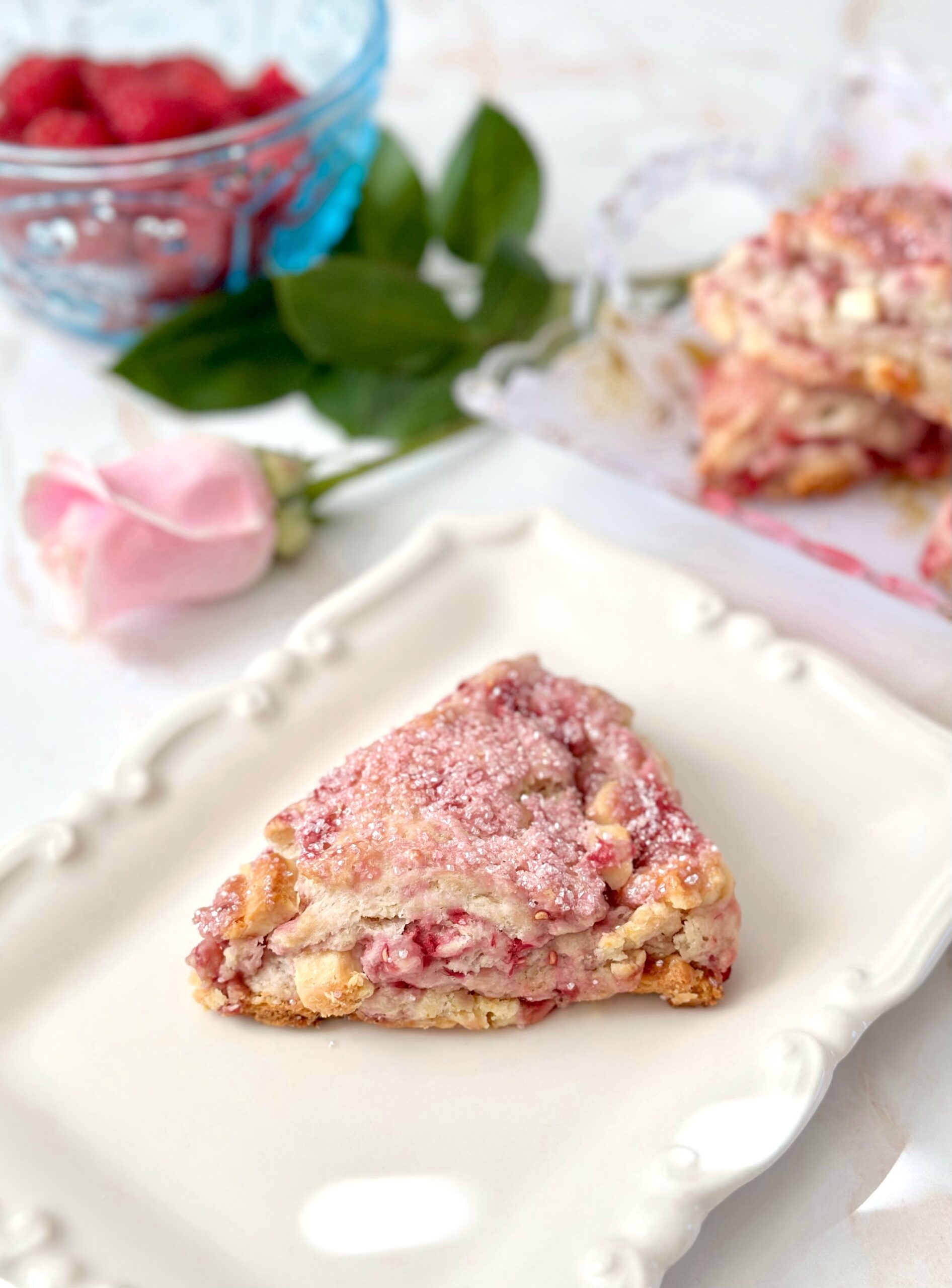
A good scone has a way of making you feel elegant, especially if you pronounce it ‘skon’ instead of ‘skōne’. I went to a lovely tea recently where scones were served, along with an array of dainty tea sandwiches and desserts. The scones were round with pink sugar sprinkled on top. Pretty pink food is always so promising. Unfortunately, the scones were hard, dry and bland. No amount of clotted cream slathered on them could help. There’s nothing elegant about a dry, hard bite of a scone that you have to struggle to choke down. Scones should be dense and slightly dry and crumbly, but there’s no reason we can’t make them more delicious. It’s fun to add fruit, chocolate, herbs, nuts or whatever you like to make them more delightful. These Raspberry White Chocolate Scones are tender and buttery with bursts of flavor from the fresh raspberries and white chocolate. I added pink sparkling sugar for texture and, of course, to make them look pretty!


Raspberry White Chocolate Scones

by Mari Vasseur
Tender scones with fresh raspberries and white chocolate, topped with crunchy sparkling sugar.
Course Breakfast, Brunch
Servings 8 scones

Ingredients
  

  • 1 ¾ cups (226g) all purpose flour, sifted
  • 1 tablespoon baking powder
  • ½ teaspoon fine sea salt
  • 7 tablespoons (100g) cold, unsalted butter, cubed
  • ½ cup (118 ml) cold heavy cream plus extra for the tops of the scones
  • ¼ cup (57g) cold sour cream
  • 1 teaspoon pure vanilla extract
  • ¾ cup (128g) white chocolate chips or chunks Not chopped white chocolate
  • ¾ cup (113g) fresh or frozen raspberries
  • Pink or white coarse sparkling sugar

Instructions
 

  • Line a large baking sheet with parchment paper.
  • In a large bowl, whisk the flour, baking powder and salt together until well combined. Work the butter into the flour mixture with your fingertips or with a pastry blender until pea size pieces form.
  • In a small bowl, whisk together the heavy cream, sour cream and vanilla until well blended. Stir the cream mixture into the flour mixture until a shaggy dough forms. Gently fold in the white chocolate chips and raspberries.
  • Turn the dough out onto a lightly floured surface. Form the dough into a 1-inch thick round, about 6 1/2 inches in diameter. Cut the dough into 8 wedges.
  • Place scones 2 inches apart on the prepared baking sheet. Chill the scones in the refrigerator for 20 minutes.
  • Meanwhile, preheat the oven to 375ºF (190ºC). Brush the tops of the scones with heavy cream. Sprinkle with coarse sugar.
  • Bake until the edges look golden brown, about 20-24 minutes. Transfer the scones to a cooling rack.

Notes

*To find pink sparkling sugar, click here.  
This recipe was updated on 3/23/2023.
Keyword raspberry white chocolate, scones

Strawberries & Cream Tarts

Strawberries & Cream Tarts

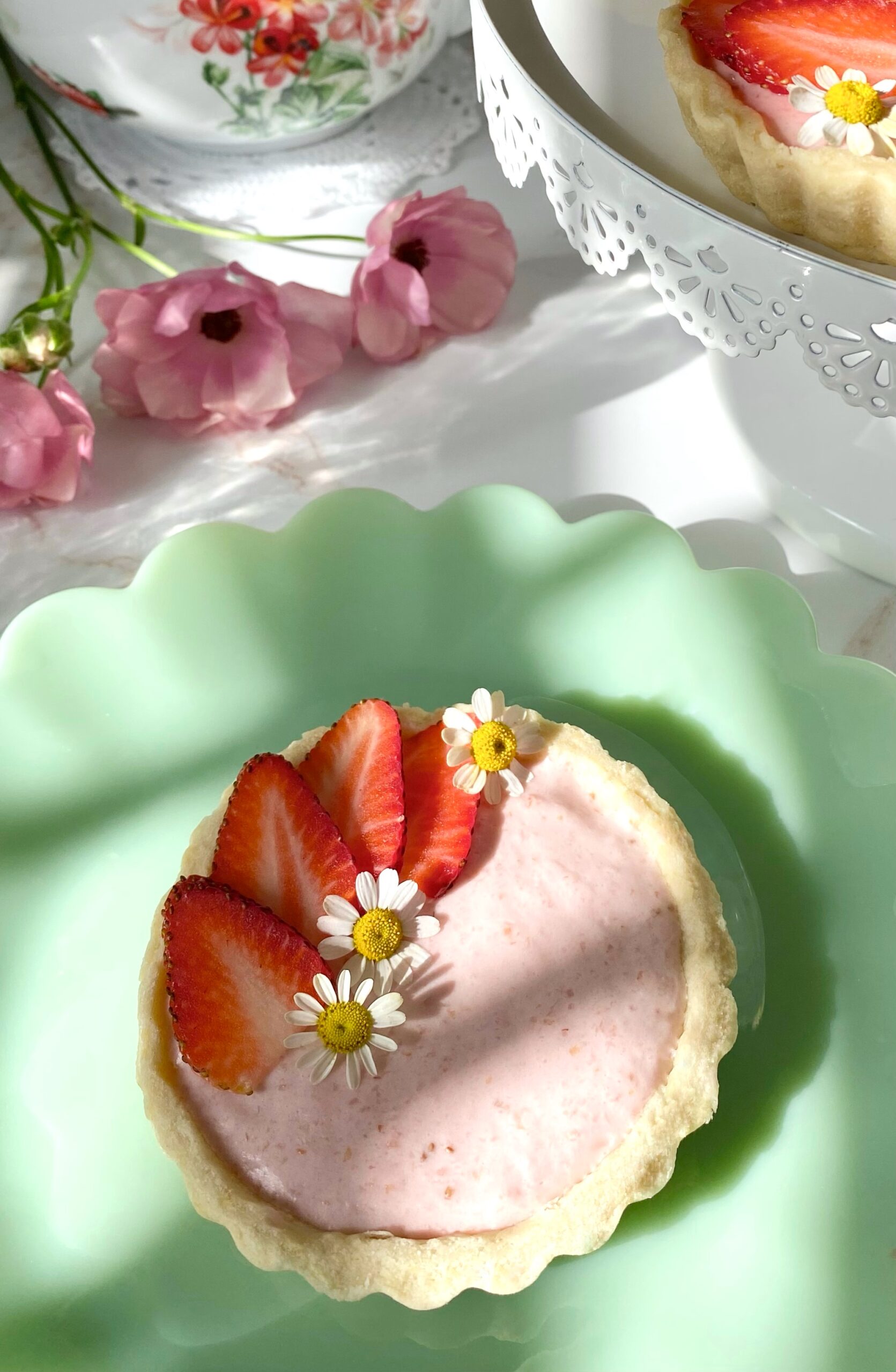
May is when I get to pull out all of my summery recipes. These pretty little Strawberries & Cream Tarts remind me of a summer day. The kind of day when you’re outside enjoying the sunshine and you’re craving a cool, refreshing dessert. This strawberry cream filling alone is so delicious that I could just eat the entire bowl with a spoon. But since I’m extra, I had to create an aesthetic dessert with it.

I used my favorite tart shells for this recipe, but this would also be delicious with those little pre-made graham cracker pie crusts if you want to take a shortcut. The reason I love this tart crust recipe so much though, is that it actually tastes delicious. Once, a few years ago, I purchased a beautiful, small fruit tart from a famous bakery. The fruit was vibrant and glistening and the pastry cream filling was sweet and silky. Now we need the sound of a mic drop, because the tart crust was hard and flavorless, like cardboard! Ever since then, I knew I would settle for nothing less than a delicious tart crust.

Strawberries & Cream Tarts

Course Dessert
Servings 6 4-inch tarts

Ingredients
  

Tart Crust

  • 1 ½ cups (6.75 ounces) all purpose flour, sifted
  • ¼ cup (1 ounce) powdered sugar, sifted
  • ¼ teaspoon fine sea salt
  • ½ cup (4 ounces) cold, unsalted butter, cubed
  • 1 egg yolk
  • 1-2 tablespoons ice water

Strawberry Cream Filling

  • 2 cups (16 ounces) strawberry puree Plus more for garnish
  • ½ cup (3.5 ounces) granulated sugar
  • 3 tablespoons water
  • 2 teaspoons unflavored gelatin powder
  • ½ cup (4 ounces) cream cheese, softened
  • ½ teaspoon strawberry extract
  • ½ teaspoon vanilla extract
  • ½ cup (4 ounces) cold heavy whipping cream

Instructions
 

Tart Crust

  • In a bowl, whisk together flour, powdered sugar and salt. Set aside.
  • Work in butter and egg yolk with a pastry blender or with your fingers, until pea size pieces are formed.
  • Add ice water, one tablespoon at a time, until dough comes together.
  • Form dough into a disc. Wrap in plastic and refrigerate for one hour.
  • On a lightly floured surface, roll dough to a scant 1/4-inch thickness
  • Cut dough into six 5-inch rounds. Press rounds into six 4-inch or 4 1/4-inch tart pans.*
  • Dock the bottoms of pie crusts with a fork. Freeze for 30 minutes.
  • Heat oven to 375ºF. Place tart pans on a large baking sheet.
  • Line tart shells with six 6-inch parchment rounds. Fill with pie weights. (You can use dried beans or rice if you don't have pie weights.)
  • Bake tart shells for 12 minutes. Remove parchment paper and pie weights. Continue baking until tart shells are light golden brown, about 4-6 more minutes.
  • Transfer to cooling rack to cool completely.

Strawberry Cream Filling

  • Pass the strawberry purée through a mesh sieve to remove large seeds.
  • In a medium saucepan, simmer the strawberry purée until it's reduced by half. Stir in the sugar and continue cooking over medium heat, until the sugar is dissolved. Transfer to a medium bowl.
  • Meanwhile, place 3 tablespoons of water into a small bowl. Sprinkle gelatin powder over the top of water. Let sit until water is absorbed, about 5 minutes.
  • Pour the gelatin mixture into the warm strawberry reduction mixture and stir until fully incorporated.
  • In a large bowl, beat cream cheese on low speed with an electric mixer until smooth.
  • Add extracts and beat until combined.
  • Add the strawberry reduction mixture to the cream cheese a little at time. Beat until well combined.
  • In a medium bowl, beat heavy whipping cream with an electric mixer at high speed until stiff peaks form.
  • Fold whipped cream into strawberry mixture.
  • Spoon into cooled tart shells. Smooth tops with a small offset spatula. Refrigerate for two hours. Garnish with sliced, fresh strawberries.

Notes

*To find the tart pans I used, click here.
Keyword strawberry, tarts